


Educational Support Programs
Enrichment, Barton Reading & Spelling, NILD, and other resources are available.
Believing that each child is uniquely created by God and is fearfully and wonderfully made, Immanuel Christian School seeks to address the differing educational needs of all our students. Advanced learners benefit from our enrichment program, and our students with learning challenges are strengthened by Educational Support Services, including the Barton Reading and Spelling System and NILD therapy.
Educational testing is generally required for students seeking admission who may have an indication that support services will be necessary for academic success since our programs have a limited number of openings and do not support all learning needs.
Explore resources
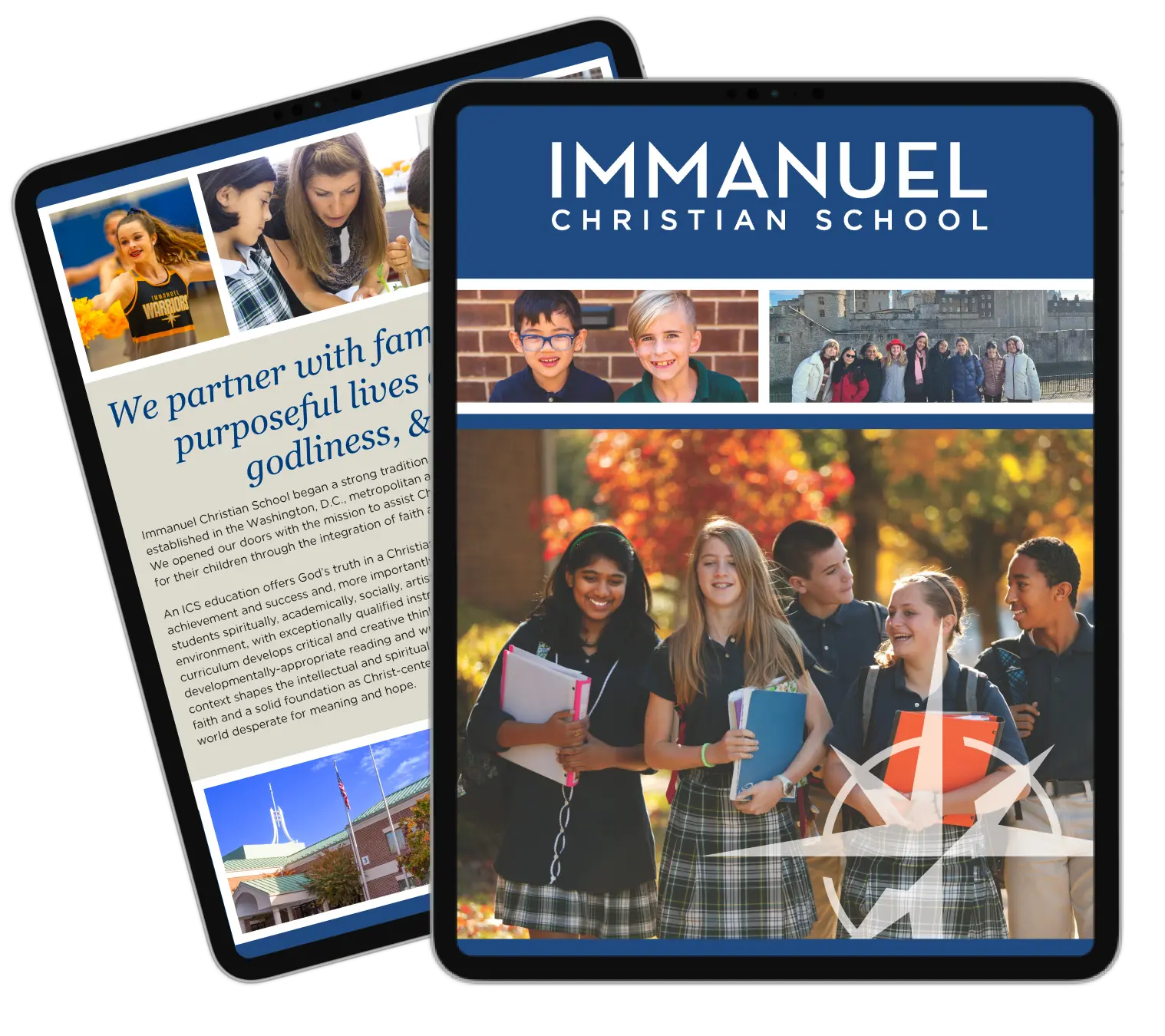
Inspiring
purposeful lives
IMMANUEL CHRISTIAN SCHOOL
Educational Resource Services
Educational Resources Services are the way we support students with learning challenges. Our School Resource Team (SRT), including resource teachers, classroom teachers, administrators, and other school faculty, meets each month to review data, collaborate, and make recommendations to support student success. All information and recommendations are shared with parents, as part of the collaborative teamwork process.
Regardless of the age of the student, resource teachers work closely with students, both with in-class support and small group instruction, to ensure personalized Educational Support Plans (ESPs) are implemented to support the flourishing of each learner at ICS.
Educational Service Plans (ESPs)
We believe that early intervention is critical for long-term positive outcomes. In addition to collecting our own school-based data, students may be referred for educational testing by a licensed psychologist who can identify the student’s specific learning deficits. Resource teachers will guide parents through the process of obtaining an assessment through the public school system or make referrals for private practitioners. This report can provide valuable information that can guide the intervention and strategies provided to students. If the educational testing indicates a learning disability and data indicates a deficit or barrier to access grade level learning, accommodations may be provided in an Educational Service Plan (ESP).
K-8 Educational Support Services
Advanced learners benefit from our enrichment program. Our experienced resource teachers support students with learning challenges, as well as their parents and teachers. We offer on-site one-on-one Educational Support Services, including the Barton Reading and Spelling System and NILD therapy.
At the lower school level (K-4th grade), resource teachers work with students to help identify potential learning challenges and support classroom teachers with strategies and data collection. Resource teachers may also provide support for students in a small group setting to provide intervention on a short-term basis and our reading specialist provides targeted small group reading intervention.
At the middle school level (5th-8th grade), resource teachers provide executive function coaching and support during Advisory and Study Hall for students who are on Educational Service Plans (ESP).
K-8 Educational Supports
NILD Educational Therapy® is a process developed by the National Institute for Learning Development and is practiced across the United States and around the world. ICS therapists are trained and certified by NILD and receive training on an ongoing basis.
NILD Educational Therapy® is not tutoring but a collaborative effort between therapist and student designed to strengthen foundational skills, knowledge, and processes. Each student in the program meets individually with an educational therapist twice a week for activities designed to stimulate their cognitive weaknesses and sharpen cognitive strengths. NILD Educational Therapy students have individual accommodations documents, similar to public school IEP or 504 Plans. Most students will need to remain in NILD Educational Therapy® for a minimum of three years with gains usually being made each year.
It is our desire that our students will become independent learners, working to their potential without continued intervention.
The Barton Reading and Spelling System helps strengthen reading and spelling skills. Students meet individually with a Barton Specialist for two one-hour sessions each week. The program emphasizes the auditory awareness essential to reading and spelling and is based on the well-known Orton-Gillingham approach to phonics. While originally created for students with dyslexia, the program has proven to be so successful that it is recommended for use with any student who has reading or spelling difficulty. Barton sessions begin with exercises designed to build phonemic awareness, which is the ability to hear, identify and use the smallest units of sound. The study continues with the sounds and spellings of short vowels, blends, closed and unit syllables, multi-syllable words, vowel teams, prefixes and suffixes. Along with reading, the student learns rules for spelling. Students meet individually with educational therapists for two one-hour sessions each week.
High School Educational Support Services
In high school, the resource teacher offers support through check-ins, helping students develop strategy ownership and self-advocacy skills, and small group executive functioning skills coaching during Activity Period. The resource teacher also partners with teachers to support students in the classroom.
Many students with learning differences thrive in the school’s small educational setting and our school counselors support them in making the right decisions about course selections. Our goal is to support students on their journey to reaching their highest potential.
An educational evaluation may be required for students seeking admission who may need support services for academic success.
High School Educational Supports
All students participate in in-school advisory time facilitated by teachers. This helps students receive additional one-on-one or small group review of material, stay on top of their assignments, and avoid becoming overwhelmed. Advisory provides opportunities for students to:
All students participate in in-school advisory time facilitated by teachers. This helps students receive additional one-on-one or small group review of material, stay on top of their assignments, and avoid becoming overwhelmed. Advisory provides opportunities for students to:
- Ask questions
- Receive additional homework help
- Work independently
- Collaborate with peers
- Complete late or missed work
During the first quarter, all freshmen participate in a workshop series designed to help them transition successfully into high school. Topics include:

Now that you know more about our school, we’d love the chance to get to know your family better. Please feel free to contact our Admissions Team at (703) 941-1220 or via email at admissions@icsva.org.